We use cookies to make your experience better. To comply with the new e-Privacy directive, we need to ask for your consent to set the cookies. Learn more.


Tips for Modeling Bridge Scour
Bridge scour is one of the leading causes of bridge failure during flood events, making accurate analysis essential for design, inspection, and risk assessment. The Surface-water Modeling System (SMS) provides tools that support hydraulic modeling workflows used to evaluate scour potential around bridge piers, abutments, and channels. By combining good modeling practices with SMS capabilities, engineers can produce more reliable and defensible scour analyses.
Understand the Role of Hydraulics in Scour
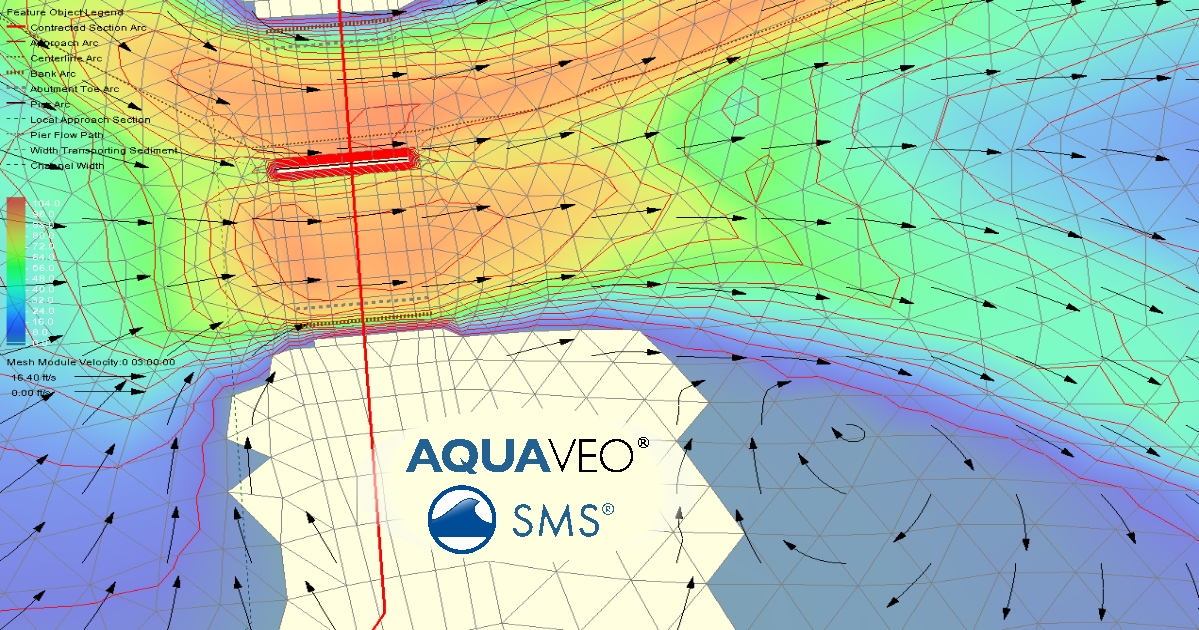
Scour is driven by flow velocity, depth, and turbulence around bridge structures. While SMS does not replace dedicated scour equations, it provides the hydraulic results—such as velocity fields and water surface elevations—needed to estimate scour using established methods (e.g., HEC-18 guidance).
-
Before focusing on scour outputs, ensure your hydraulic model is well calibrated. Errors in flow conditions will directly affect scour predictions.
Build High-Quality Geometry Around the Bridge
Accurate geometry is critical when modeling bridge scour. In SMS, use coverages and feature objects to carefully define:
-
Channel alignment
-
Bridge opening and deck footprint
-
Pier and abutment locations
-
Overbank and floodplain areas
Refine geometry around the bridge using well-placed arcs and polygons. Higher detail in these areas ensures the mesh captures flow contraction and acceleration—key drivers of scour.
Refine the Mesh Strategically
Mesh resolution should be finer near piers, abutments, and constrictions where velocity gradients are highest. Instead of refining the mesh directly, use the Map Module to control density through geometry and vertex spacing.
-
Avoid over-refining the entire domain. Focus computational effort where it matters most—around the bridge structure.
Use SMS Visualization Tools to Identify Scour Risk
After running your simulation (e.g., with SRH-2D), use SMS tools to evaluate:
-
Velocity magnitude and vectors near piers
-
Flow contraction zones at bridge openings
-
Water surface elevation changes upstream and downstream
High velocities and abrupt flow transitions often indicate areas susceptible to local or contraction scour.
Apply Bridge Scour Calculations Carefully
SMS supports workflows that integrate with scour evaluation methods (such as HEC-RAS-based approaches or external calculations). When using these tools:
-
Verify that hydraulic inputs (depth, velocity) are extracted correctly
-
Ensure cross sections or observation points are placed appropriately
-
Compare results across multiple flow events (e.g., 10-year, 50-year, 100-year floods)
Watch for Common Pitfalls
-
Poor geometry definition → leads to unrealistic flow patterns
-
Insufficient mesh resolution near structures → underestimates velocities
-
Boundary conditions too close to the bridge → distorts results
-
Ignoring sediment assumptions → limits interpretation of scour depth
Conclusion
Modeling bridge scour in SMS requires a combination of accurate geometry, thoughtful mesh refinement, and careful interpretation of hydraulic results. By leveraging SMS tools and following best practices, engineers can better understand scour risks and support safer bridge design and evaluation. Start modeling bridge scour by downloading SMS today!
May 19, 2026
|
View: 1663
|
Categories: SMS
|
By: <a class="mp-info" href="https://aquaveo.com/blog/author/admin">Aquaveo Staff</a>
About the Author


Converting a NET File to an INP File
May 9, 2018
Performing a Silent Install of XMS (Passwords & Hardware Locks)
October 10, 2018
Computing Basin Curve Numbers in 9 Easy Steps
May 16, 2023
Performing a Silent Install for ALS
October 27, 2021
Tips for Finding Information on the XMS Wiki
September 25, 2019
Meet the New Display Panel
October 13, 2026
What’s New in the GMS 11.0 Beta
October 6, 2026
Simplify and Prepare Complex Geometry
September 29, 2026
Unlock SMS 14.0 Map Undo Features
September 22, 2026
Advanced Groundwater Modeling Techniques for 3D Data
September 15, 2026