We use cookies to make your experience better. To comply with the new e-Privacy directive, we need to ask for your consent to set the cookies. Learn more.


Tips for Calibration with PEST and MODFLOW 6
A groundwater model is only as good as its calibration. While building a conceptual model and assigning realistic hydraulic properties are essential, calibrating your model against observed field data is what gives you confidence in its predictive capabilities. The Groundwater Modeling System (GMS) integrates PEST (Parameter ESTimation) with MODFLOW 6, making it easier to automate calibration and evaluate model performance. Recent enhancements in GMS 10.9 further streamline the calibration process with improved support for observations, visualization, and statistics.
Start with Quality Calibration Data
Before launching PEST, verify that your calibration targets are based on reliable field measurements. Common observation types include:
-
Groundwater heads
-
Drawdown measurements
-
Streamflow observations
-
Spring discharge
-
Groundwater contaminant concentrations
A well-distributed set of observations across the model domain generally produces more robust calibration results than relying on a few clustered monitoring wells.
Take Advantage of MODFLOW 6 Observation Enhancements
GMS 10.9 includes several improvements that make working with PEST observations more efficient.
One significant enhancement is support for concentration observations from MODFLOW 6 transport models. This allows modelers to calibrate not only groundwater flow but also contaminant transport simulations, making it possible to match observed concentration data alongside hydraulic heads. This capability is particularly valuable for remediation studies, PFAS investigations, and other groundwater quality projects.
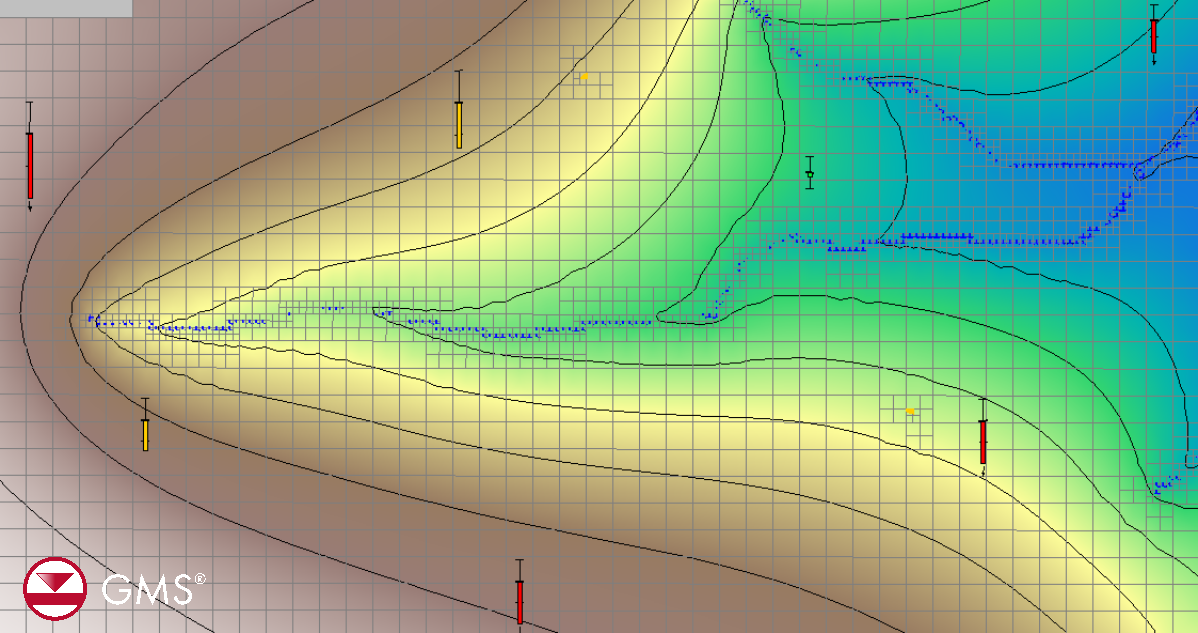
Visualization has also improved. PEST calibration targets now display above other map objects, making observation locations easier to identify while editing a model. This seemingly small enhancement helps prevent overlooked targets in projects with complex coverages.
Improve Visualization During Calibration
Understanding calibration results is easier when observations are displayed clearly. GMS now allows users to define default display options for PEST observation solution coverages, creating a consistent appearance across projects.
In addition, logarithmic scaling is now supported for PEST observation targets. This is especially useful when working with datasets that span several orders of magnitude, such as contaminant concentrations or hydraulic conductivity estimates.
Use Observation Statistics to Guide Improvements
Rather than relying solely on visual comparisons, GMS now provides observation statistics for each coverage. Reviewing residuals, error distributions, and summary statistics helps identify areas where model performance can be improved and where additional field data may be beneficial.
Remember that calibration should not simply minimize error—it should produce parameter values that remain physically reasonable and consistent with the site's hydrogeology.
Final Thoughts
The latest PEST enhancements in GMS make calibrating MODFLOW 6 models more informative and efficient than ever. From support for transport-model concentrations to improved visualization and observation statistics, these tools help groundwater professionals build better-calibrated, more defensible models.
Download GMS today to take advantage of PEST and MODFLOW 6.
August 4, 2026
|
View: 954
|
Categories: GMS
|
By: <a class="mp-info" href="https://aquaveo.com/blog/author/admin">Aquaveo Staff</a>
About the Author


Converting a NET File to an INP File
May 9, 2018
Performing a Silent Install of XMS (Passwords & Hardware Locks)
October 10, 2018
Computing Basin Curve Numbers in 9 Easy Steps
May 16, 2023
Performing a Silent Install for ALS
October 27, 2021
Tips for Finding Information on the XMS Wiki
September 25, 2019
What’s New in the GMS 11.0 Beta
October 6, 2026
Simplify and Prepare Complex Geometry
September 29, 2026
Unlock SMS 14.0 Map Undo Features
September 22, 2026
Advanced Groundwater Modeling Techniques for 3D Data
September 15, 2026
Best Practices and Tips for Using SWMM with WMS
September 8, 2026