We use cookies to make your experience better. To comply with the new e-Privacy directive, we need to ask for your consent to set the cookies. Learn more.


Smart Guide to MT3D vs MODPATH
When working with groundwater models in the Groundwater Modeling System (GMS), it is important to choose the right tool for the question you are trying to answer. MODPATH and MT3D are both used with MODFLOW groundwater flow models, but they serve different purposes. One tracks the movement of particles through the simulated flow field, while the other simulates the movement and fate of dissolved contaminants.
Understanding the difference between MT3D and MODPATH can help you select the appropriate approach for your groundwater modeling project.
Use MODPATH to Analyze Groundwater Flow Paths
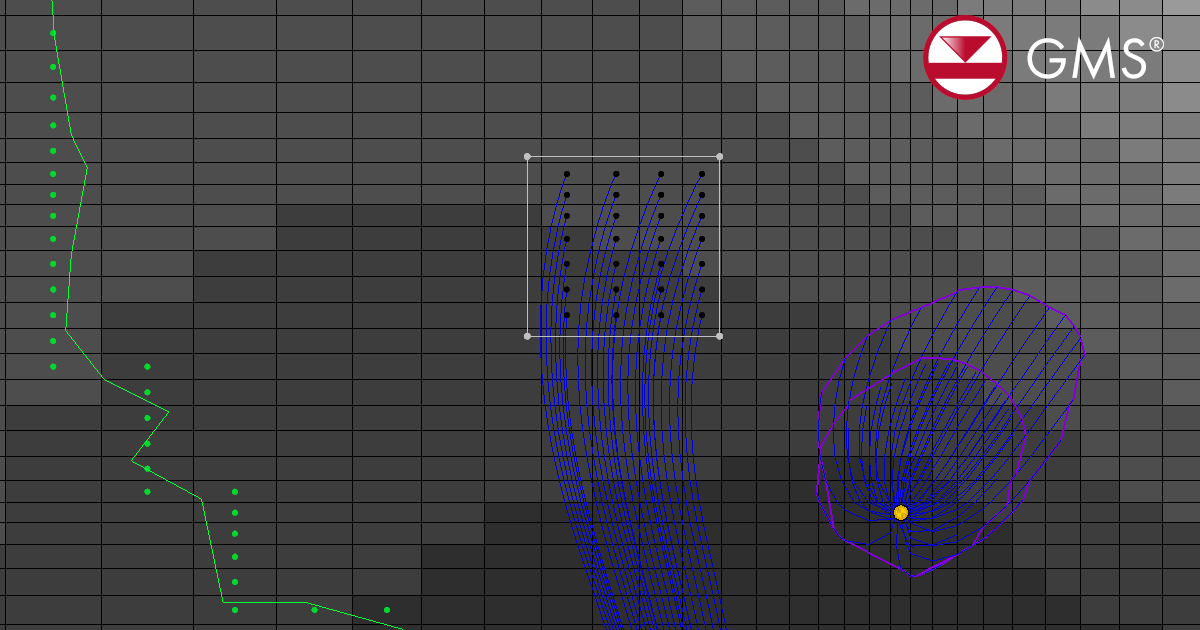
MODPATH is a particle-tracking model that uses the groundwater flow solution produced by MODFLOW to calculate three-dimensional flow paths. Particles are transported by advection through the simulated groundwater velocity field.
Choose MODPATH when you want to answer questions such as:
-
Where does groundwater reaching a pumping well come from?
-
Where will groundwater from a recharge area travel?
-
How long does groundwater take to travel between two locations?
-
What is the capture zone of a well?
-
Which portions of an aquifer contribute water to a discharge point?
For example, backward particle tracking from a municipal well can help delineate the area contributing groundwater to the well. Forward tracking can show where groundwater originating from a selected location is likely to travel.
MODPATH is therefore particularly useful for capture-zone analysis, groundwater travel times, flow-path visualization, and wellhead protection studies.
Use MT3D to Simulate Contaminant Transport
Use MT3D, including MT3DMS or applicable MT3D-USGS workflows in GMS, when the project requires simulation of a dissolved substance moving through groundwater. MT3DMS can simulate advection, dispersion, and chemical reactions of dissolved constituents.
Choose a transport model when questions involve:
-
Contaminant plume migration
-
Concentration changes over time
-
Dispersion and mixing
-
Sorption or decay
-
Multiple chemical species
-
Remediation scenarios
Unlike MODPATH, a transport model can simulate how a contaminant concentration changes as it moves through the aquifer. MT3D-USGS also adds capabilities for processes such as unsaturated-zone, stream, and lake transport.
MT3D vs. MODPATH: Which Should You Choose?
A simple way to decide is to ask whether you need to model where groundwater moves or what happens to a dissolved substance as it moves.
Choose MODPATH for groundwater flow paths and travel-time questions. Choose MT3D when concentration, dispersion, reactions, or contaminant fate and transport are important to the analysis.
The two approaches can also complement each other. A project might use MODPATH to understand groundwater pathways and travel times before developing a more detailed contaminant transport model.
Note: Practical implementation of these models requires carefully defining model-specific transport packages, dispersion coefficients, and appropriate boundary conditions to accurately represent site-specific hydrogeologic processes.
Final Thoughts
MODPATH and MT3D are not competing versions of the same model. They answer different groundwater modeling questions. Selecting the appropriate model in GMS begins with clearly defining whether the project requires particle tracking or solute transport. Starting with that distinction can help create a model that is appropriately complex for the project's objectives.
Make use of both MODPATH and MT3D by downloading GMS today!
October 27, 2026
|
View: 53
|
Categories: GMS
|
By: <a class="mp-info" href="https://aquaveo.com/blog/author/admin">Aquaveo Staff</a>
About the Author


Converting a NET File to an INP File
May 9, 2018
Performing a Silent Install of XMS (Passwords & Hardware Locks)
October 10, 2018
Computing Basin Curve Numbers in 9 Easy Steps
May 16, 2023
Performing a Silent Install for ALS
October 27, 2021
Tips for Finding Information on the XMS Wiki
September 25, 2019
Smart Guide to MT3D vs MODPATH
October 27, 2026
How to Calibrate a HEC-HMS Model for Peak Flow Accuracy
October 20, 2026
Meet the New Display Panel
October 13, 2026
What’s New in the GMS 11.0 Beta
October 6, 2026
Simplify and Prepare Complex Geometry
September 29, 2026