We use cookies to make your experience better. To comply with the new e-Privacy directive, we need to ask for your consent to set the cookies. Learn more.


How to Decide between Structured or Unstructured Grids
Every successful hydraulic model begins with the right grid. Choosing the correct grid type is a critical decision when building hydraulic models in the Surface-water Modeling System (SMS). Although SMS supports both structured and unstructured grids, each serves a distinct purpose and is tied to different SMS modules and numerical models. Understanding these differences upfront helps you avoid rework, streamline your workflow, and build more reliable models from day one.
Structured or unstructured? Delve into when and where to use each to level up your SMS projects!
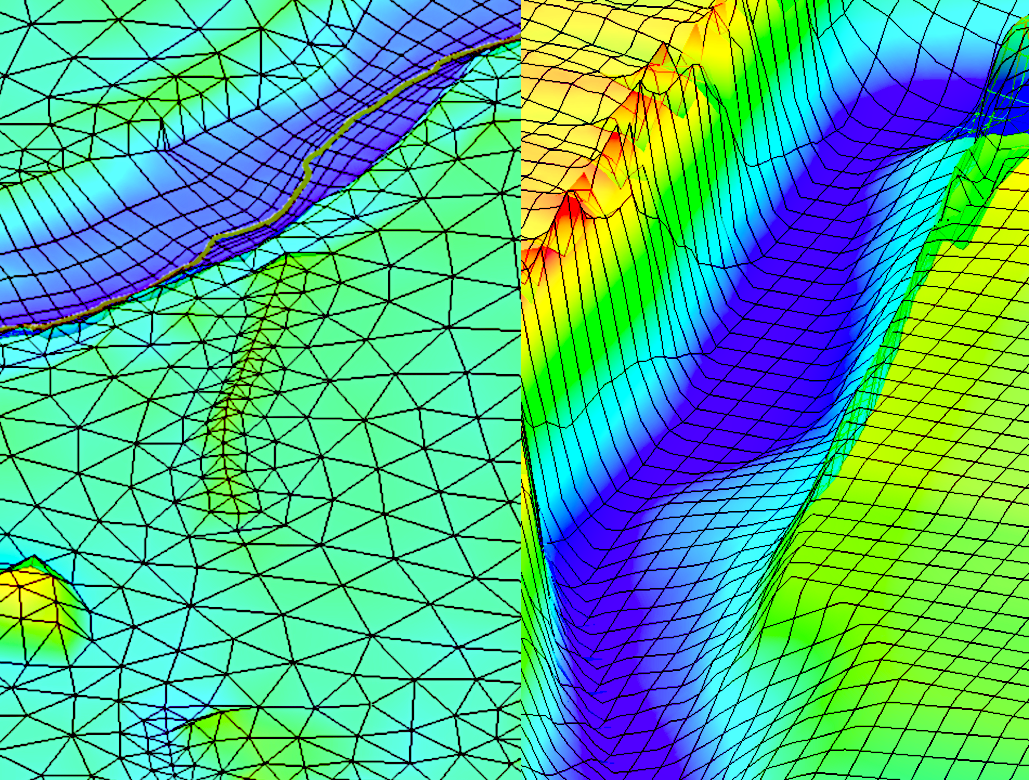
Structured Grids in SMS
Structured grids in SMS are created using the 2D Grid modules and offer a fast, proven approach to hydraulic modeling. These grids are typically Cartesian or curvilinear, with cells arranged in a regular row-and-column pattern. Their implicit connectivity helps deliver stable performance for problems where simplicity and speed are key.
Models That Use Structured Grids
Structured grids in SMS are used with models such as:
-
BOUSS2D
-
TUFLOW 2D
-
WAM
-
Other legacy or specialized models that require structured topology
When to Use Structured Grids
Structured grids are an excellent choice for projects in SMS where:
-
The modeling domain is geometrically simple
-
Flow direction is relatively uniform
-
Computational efficiency is a priority
-
Large areas can be represented with consistent resolution
Limitations
-
Difficult to represent complex boundaries
-
Inefficient refinement around localized features
-
Can require a large number of cells to capture detail
Unstructured Grids in SMS
Unstructured grids in SMS are built using the 2D Mesh and 2D UGrid modules, providing maximum flexibility for complex modeling challenges. By leveraging triangular or mixed elements, these grids allow cell size and shape to vary across the modeling domain, offering the adaptability needed to accurately represent complex boundaries and flow behavior.
Models That Use Unstructured Grids
Unstructured grids are used by many modern hydraulic models in SMS, including:
-
SRH-2D
-
HEC-RAS 2D (via UGrid import/export)
-
ADCIRC (unstructured meshes)
-
CMS-Flow
When to Use Unstructured Grids
Unstructured grids are ideal when:
-
The domain contains complex geometry (channels, levees, structures)
-
Localized refinement is required
-
Accurate representation of hydraulic features is critical
-
Boundaries are irregular or highly detailed
Limitations
-
Requires more careful mesh quality control
-
Longer setup time compared to structured grids
-
Slightly higher computational overhead
Choosing the Right Grid Type in SMS
In practical riverine and floodplain applications, SMS projects benefit from the adaptability of unstructured grids; which provide the level of flexibility required to capture complex terrain and hydraulic features. Structured grids remain a reliable option for simplified geometries and screening-level studies. SMS’s modular design will usually select the optimal grid and model combination, ensuring efficiency without sacrificing accuracy.
Successful hydraulic modeling starts with informed decisions, and grid selection is one of the most impactful choices you’ll make. By knowing which SMS models support structured or unstructured grids and leveraging the correct modules, you can avoid unnecessary setbacks while producing reliable, high-quality results. Try out SMS’s grid capabilities by downloading SMS today!
March 3, 2026
|
View: 2102
|
Categories: SMS
|
By: <a class="mp-info" href="https://aquaveo.com/blog/author/admin">Aquaveo Staff</a>
About the Author


Performing a Silent Install of XMS (Passwords & Hardware Locks)
October 10, 2018
Converting a NET File to an INP File
May 9, 2018
Computing Basin Curve Numbers in 9 Easy Steps
May 16, 2023
Performing a Silent Install for ALS
October 27, 2021
Tips for Finding Information on the XMS Wiki
September 25, 2019
Tips for Calibration with PEST and MODFLOW 6
August 4, 2026
Tips for Using Wells with MODFLOW 6
July 14, 2026
Enhanced Arc Geometry and Vertex Tools
July 7, 2026